Difference Between Rocks and Minerals
For those of you that are just getting started in the rock collecting hobby, asking what the difference between rocks and minerals is, is something you’ve probably already asked yourself. Heck, it’s a question even experienced rock collectors ask! So I thought I’d try to answer this question right off the bat here and provide you with a simple answer. So lets dive right in!
Rocks vs Minerals
According to Wikipedia, “A mineral is a naturally occurring, inorganic solid with a definite chemical composition and a crystalline structure formed by geological processes. A rock is an aggregate of one or more minerals whereas a rock may also include organic remains and mineraloids. Some rocks are predominantly composed of just one mineral.”
Let’s Break It Down!
OK, so let’s take Wikipedia’s definition and break it down a bit so all of us can really understand the difference between rocks and minerals. Because for me, Wiki’s answer isn’t completely satisfactory.
Minerals
Minerals are crystal-like objects that are made from a specific chemical substance.
Rocks
Rocks are made from multiple minerals combined together. In other words, when you hold a rock in your hand, you are actually holding a number of different kinds of minerals.
But…when you hold a mineral, you are only holding one single mineral.
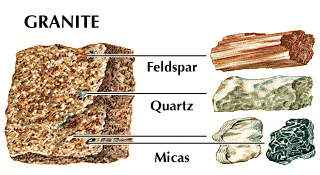
Take a look at the photo above. Granite is a rock that most of us are pretty familiar with. But what makes up the rock granite are 3 different minerals combined into one material.
I realize this is an over simplified answer…but for me it’s an easy way to remember the difference.
Rocks vs Minerals: Break It Down Some More
I found this video on youtube that I thought does a good job of explaining the difference between rocks and minerals.
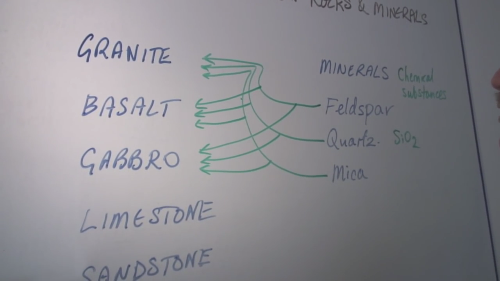
The left side has a list of 5 different rocks including granite, basalt and gabbro.
On the right is a list of 3 different minerals: Feldspar, quartz and mica.
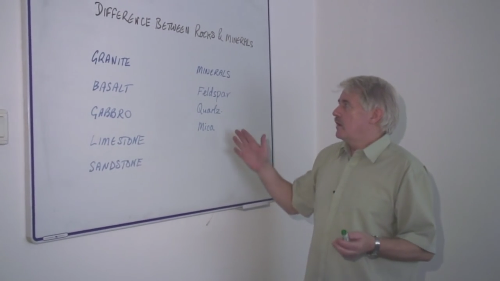
As I mentioned earlier, minerals are simply just made of certain chemical substances.
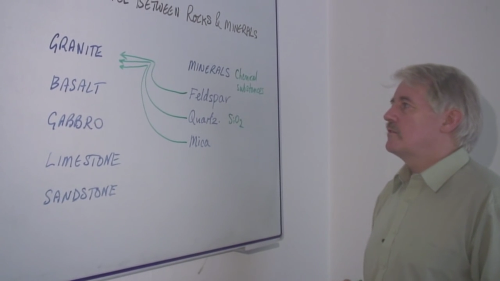
Granite is a type of rock. But what is granite made of? Well, we know that rock is made up from multiple individual minerals, right?
So here, the arrows from all three minerals are pointing towards the granite. So granite is made from the minerals Feldspar, Quartz and Mica!
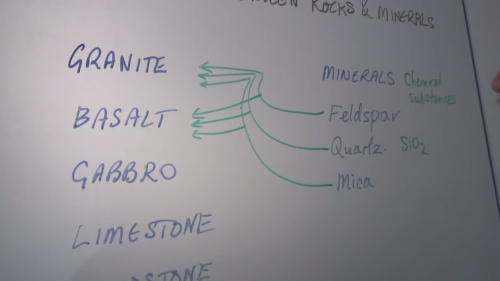
Basalt, another kind of rock, is also made out of the same minerals Feldspar, Quartz and Mica. But how can this be? Why is it Basalt and not granite if it’s made from the same minerals?
They are not the same because different amounts of each mineral make up each kind of rock. Granite has a completely different amount of quartz in it then basalt does.
The same thing goes for Gabbro. Gabbro also contains the three minerals Feldspar, Quartz and Mica. But again, the amount of each mineral in gabbro is totally different than the amount of minerals found in basalt. It’s also completely different than the amount of minerals found in granite.
Final Thoughts
This is a very simplified answer to the question what’s the difference between rocks and minerals. But this Rock Seeker really likes simplified answers!
If you’re serious about really diving deep into learning about rocks and minerals, then this is a great handbook.
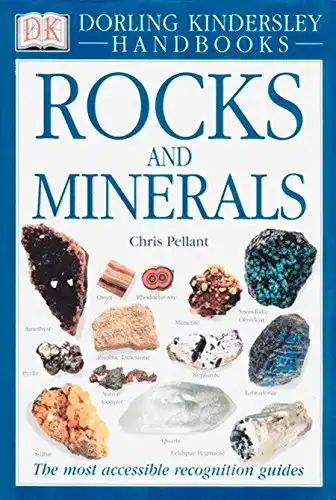
The Smithsonian Handbook On Rocks And Minerals is an great resource for any serious rockhound. It’s one of the first books I got my hands on when I started rockhounding more often.
It’s well written, easy to follow and simple to understand. It contains detailed information, photographs and characteristics for more than 500 rocks and minerals. This one makes an excellent beginners
- Online rock and mineral club for collectors of all levels!
- Find community with like-minded rock and mineral enthusiasts.
- Monthly Giveaways!
- Free Access to Entire Digital Library of Products (annual memberships)